- Navigation Bar
- Contact Us
- Phone: +86-185 6192 1984
- Wechat: +86-185 6192 1984
- WA: +86-185 6192 1984
- Email:3003792189@qq.com

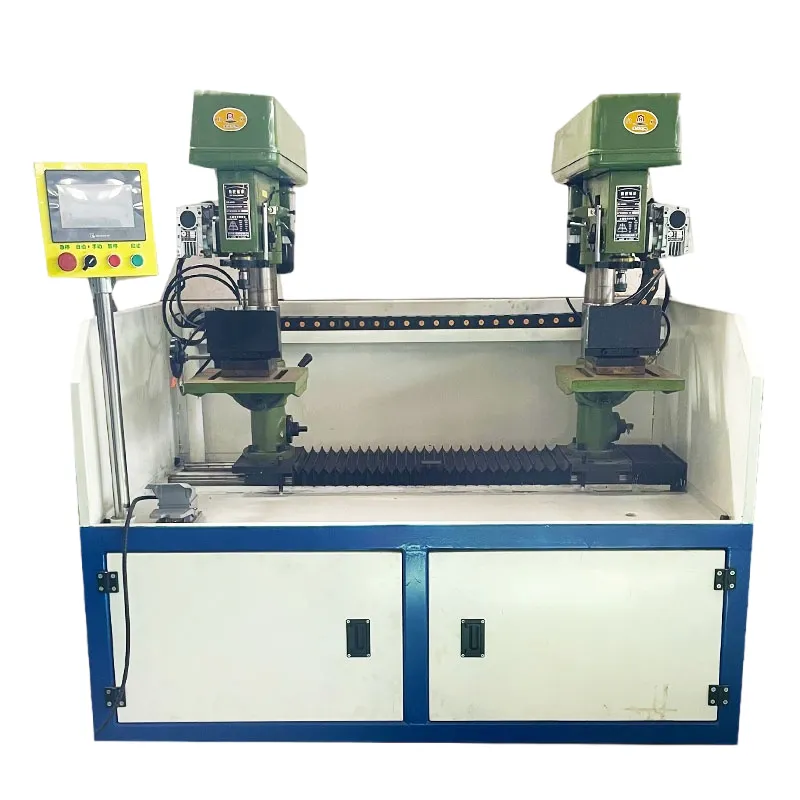
Dual-Head CNC Drilling Machine
The dual-head CNC drilling machine is a highly efficient, high-precision specialized equipment for hole processing in manufacturing. It features two independent, programmable drilling spindles that can operate synchronously or asynchronously/sequentially.
1. Innovative Design: Features a dual-head, dual-station layout equipped with high-precision ball screws and linear guides, integrated with automatic positioning, drilling, and chip removal systems for fully automated processing.
2. Performance Highlights: Drilling accuracy ≤±0.02mm, hole spacing error ≤0.03mm. Capable of simultaneously machining mounting holes and oil holes at both ends of roller shafts. Drilling efficiency is 4 times higher than traditional drilling machines, with drilling perpendicularity and surface finish far exceeding industry standards.
3. Intelligent Control: Features a touchscreen interface supporting parameter storage and program recall. Enables rapid switching between processing parameters for different product specifications, ideal for high-mix, high-volume production scenarios. A single operator can simultaneously manage 3-5 units.
Working Principle and Processing Flow
1. Loading and Positioning: Workpieces are delivered to the machine’s central worktable via manual or automated lines, then positioned and clamped by precision fixtures (such as V-blocks, three-jaw chucks, or specialized jigs).
2. CNC Program Initiation: The CNC system reads the machining program (G-code) and controls both power heads to move along the X, Y, and Z axes (typical configuration) to predetermined positions. Both spindles can operate independently or in strict synchronization.
3. Synchronous/Sequential Machining:
Synchronous Drilling: For workpieces requiring precise hole alignment at both ends, both drill bits move simultaneously toward each other, ensuring exceptional concentricity.
Sequential Machining: After completing drilling, chamfering, and tapping at one end, identical or different operations can be performed at the opposite end.
4. Automatic Tool Change: High-end models feature a disc-type tool magazine for automatic tool changes, enabling continuous completion of multiple processes—such as drilling, reaming, boring, and tapping—on a single machine, achieving high process concentration.
5. Completion and Unloading: Upon finishing all processes, the power heads retract, the fixture releases, and the workpiece is ejected.
Application Areas
Automotive Industry: Connection holes and locating holes on axles, drive shafts, half shafts, steering arms, and connecting rods.
Hydraulics and Construction Machinery: Holes at both ends of hydraulic cylinder barrels, piston rods, pump bodies, valve blocks, and excavator pins.
Aerospace: Precision components such as landing gear linkages and actuator cylinders.
Mold Industry: Guide pillar holes and cooling water holes on large mold frames and templates.
General Machinery: End hole machining for various shaft-type and sleeve-type components.。
Operating Steps
1. Before operation, thoroughly inspect whether the power supply voltage, oil pump, lubrication system, and oil level are normal. Verify the integrity of pressure systems, cooling systems, oil lines, cutting tools, and workholding fixtures. Perform scheduled maintenance on the machine tool.
2. After powering on and starting the machine tool, execute a mechanical zero return operation. Then conduct a 5-minute test run. Only after confirming the correctness of mechanical components, cutting tools, fixtures, workpieces, and CNC parameters may normal operation commence.
3. Thoroughly verify that program coding, parameter settings, motion sequencing, tool interference checks, workpiece clamping, and switch protections are entirely error-free to prevent accidents, tool damage, or component failure during cyclic machining. Strictly follow operational procedures for trial cutting and tool setting. Secure program protection after debugging completion.
4. During automatic cycle machining, ensure protective doors are securely closed. When manual operations are required while the spindle is rotating, keep your body and clothing away from rotating and moving parts to prevent entanglement accidents.
5. Spindle or turret tool magazine loading must be performed only when all mechanical movements have stopped. Coordinate carefully with team members to prevent accidents. During manual or automatic tool changes, monitor the positions of the turret, tool magazine, robotic arm, and tools. Keep your body and head clear of rotating tool areas to prevent contact injuries.
6. Secure workpieces firmly during clamping to prevent ejection accidents. After clamping, remove chuck wrenches and other adjustment tools to avoid being flung by the rotating spindle.
7. Machine operators should be capable of handling general alarm faults. In case of severe malfunctions, immediately shut off power, secure the scene, report promptly, and maintain detailed records.
8. After completing work, thoroughly clean the machine tool guideways and worktable, and accurately complete the work log.